
ACRC Researcher Logan Berner Awarded Grant to Investigate Wild Berries in a Changing Forest Landscape
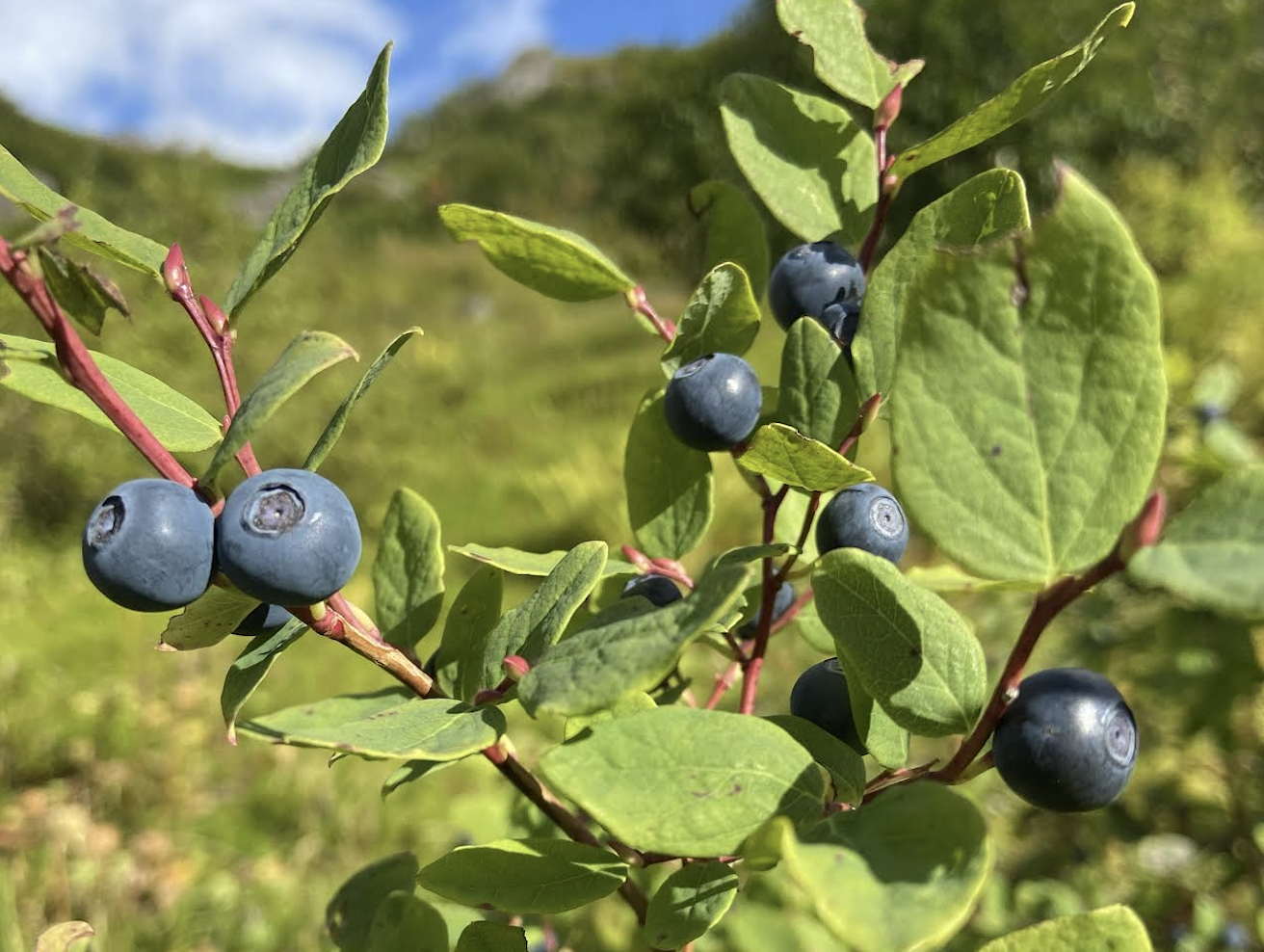
In Southeast Alaska, concerns are high that the abundance and nutritional quality of wild blueberries (Vaccinium spp.) in the region could be shifting, all while gaps in scientific berry knowledge persist, posing a threat to this culturally and ecologically important wild food cherished by its residents.
Despite their significance, we currently lack a comprehensive understanding of the environmental factors that influence the region’s wild berries. Logan Berner, newly appointed Assistant Professor of Forest Ecology at the University of Alaska Southeast and ACRC, aims to address these gaps in the upcoming fieldwork season. Recently awarded a grant through the Alaska Climate Adaptation Science Center (CASC) Ambassador Program, Berner plans to investigate how forest and climate characteristics shape the abundance and distribution of highbush blueberries in Southeast communities.
“We don’t know very much about blueberries in this region,” says Berner. “Overall, there has been little research on the topic.”
Pilot projects by the USDA Forest Service and Sitka Sound Science Center to understand berry phenology (the timing of the plant’s life cycles) have manifested in recent years, but according to Berner, there is still a lot of work to be done.
Planning to survey sites in the Southeast communities of Juneau, Sitka, and Klukwan, Berner hopes to uncover how climate gradients—from Sitka’s coastal maritime climate all the way to the drier and more continental climate in Klukwan—might impact the plant’s abundance. Highbush blueberries exist in the balance of suitable forest structure and climate characteristics, requiring just the right amount of sunlight and moisture. Dense forest canopies—as seen in young second-growth forests after logging—can diminish blueberry and other understory plants’ ability to capture sunlight and photosynthesize. Soil growing conditions can’t be oversaturated or dry, as persistently water-logged wetlands or arid areas promote environmental conditions that decrease blueberry growth.
“To understand the role that climate plays in shaping blueberry abundance, or the distribution of any type of plant, it's helpful to look at sites that span a broad range of environmental conditions,” Berner says. “You kind of want to probe the edges of their climate space. Just how dry, just how wet, can they thrive in?”
Berner will work with two undergraduate students at the University of Alaska Southeast to study sites in Juneau, Sitka, and Klukwan. The team will conduct assessments of forest type and cover, soil characteristics, and plant biomass. The diversity in study locations will enable Berner to examine how climate and environmental factors influence wild blueberries. Aiming to track the phenological events of blueberries at varying elevations and temperatures, his team will mount cameras at different elevations to reveal variations in the timing of flowering and fruit production vary over the growing season.
A central goal of this pilot project is to foster long-lasting partnerships with communities and tribes across the proposed study areas. Collaborating with the Sitka Sound Science Center, Chilkat Indian Village, and the USDA Forest Service, among other organizations, Berner hopes that this research will open doors to establish a suite of future wildberry research.
“Berries are important from a social standpoint and a cultural standpoint. Berries bring people together, including those of different generations,” Berner says. “By understanding the factors that shape blueberry abundance, we can perhaps better anticipate how future changes in climate might affect the abundance of berries. This research will allow us to better understand how forest management decisions can promote or, alternatively, adversely affect blueberry abundance in the region.”