Wild Blueberry Abundance
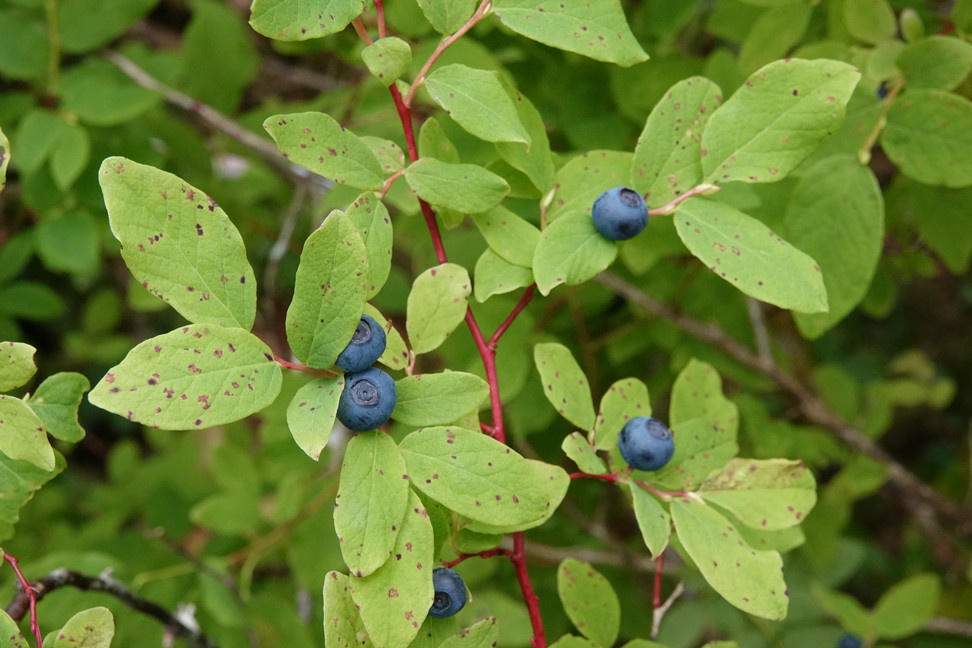
Wild Blueberry Abundance
ACRC researcher Logan Berner is working with local communities to assess how climate characteristics shape the abundance and distribution of highbush blueberries in Southeast Alaska.
In Southeast Alaska, wild blueberries (Vaccinium spp.) play an important role culturally and ecologically. Despite being one of the most widespread understory plant species in coastal Alaska, gaps remain in our understanding of the environmental factors that influence this critical wild food source. There is growing community concern about how forest management and other environmental changes are impacting the availability of berries. As an ambassador with the Alaska Climate Adaptation Science Center, ACRC researcher Logan Berner is studying the abundance of wild blueberries across several distinct climate zones. In 2026, Berner and several undergraduate students from the University of Alaska Southeast collected data at 25 survey sites in Juneau, Sitka, Klukwan, and Whittier, spanning warm and wet coastal environments to drier, more continental climates. In each plot, the team gathered information on forest type and cover and plant biomass.
Throughout this project, Berner has worked to foster long-lasting partnerships with communities and tribes across the proposed study areas. In collaboration with the Sitka Sound Science Center, Chilkat Indian Village, and the USDA Forest Service, Berner is developing field methods to create a baseline understanding of current highbush blueberry availability and identify conditions that support high berry productivity.
Contact
- Logan Berner (logan.berner@alaska.edu, Website)
Project Team
- Logan Berner (ltberner@alaska.edu, Website)
Partners & Funders